I make no secret of the fact that this is my favorite Sam rami film, yes even ahead of "Evil Dead 2" and "Army of Darkness" and all the Spider-Man movies. The reasons are apparent when you look at the trailer: it is a western, it stars Gene Hackman, and it features a badass woman with a gun. That is a formula that is hard to screw up, and when you add in Sam Rami's directing style and Sharon Stone as the Lady, it is perfect. (Which I said back in 2013).
We saw this as part of an Alamo series of films, saluting Gene Hackman and David Lynch and others. Those of you here for the first time will learn that Gene Hackman is my favorite actor and this is one of his great villain performances. John Herod is an evil prairie scum who has leveraged his way into absolute authority over a border town, and maintains control by holding a quick draw contest each year to preoccupy and identify potential threats. There is always a threat from Leo DiCaprio who may be Herod's illegitimate son. There are rival gunslingers who show up to challenge the undisputed dictator of the town of Redemption, and there is a mysterious woman who challenges the expectations of the 19th century Western Frontier, played by the aforementioned Sharon Stone.
The movie is a homage to the spaghetti westerns of Sergio Leone, borrowing heavily from "Once Upon a Time in the West" but also Leone's style. There are sequences where the close ups get closer and they linger for more time than is comfortable. There are beads of perspiration that tell stories all by themselves, and the music while not being epic like Morricone, uses the instruments they way the master would, to set mood and accentuate a scene. Alan Silvestri is a terrific composer of movie scores and his work here is equal to the task.
I listened to a podcast "That's Da Bomb" on this film, and after the BS that starts the show, there is a nice discussion of this movie, although my opinion of the film is far higher than theirs. Even better, I went back and listened to the "Lambcast MOTM from February 2022" where five of us discussed the movie in some detail. Once again, I am an outlier but I am also right. "The Quick and the Dead" rules, and there are just not enough people out there who appreciate to the degree that it deserves.
Throwback Thursday on the KAMAD site will be a regular occurrence in the next year. As a motivational project, to make sure I am working on something, even in a week where I don't see a new film in a theater, I am going to post on movies from 1975. Along with 1984, this is one of my favorite years for movies and it is full of bittersweet memories as well. 1975 was my Senior Year in High School and my Freshman Year in College. The greatest film of the last 60 years came out in 1975, as well as dozens of great and not so great cinematic endeavors. Most of the films in this weekly series will have been seen in a theater in 1975, but there are several that I only caught up with later. I hope you all enjoy.
Bite the Bullet
I have been extremely busy the last couple of weeks, including travel. This is a repost of two entries on a 1975 film that I love, but did not have time to watch again fore the project.
Next time someone tells you everything is available on line, try to get them to find the original trailer for this movie. I looked all over the place and could not find it.
[As you can see above, this has changed since the original post]
That doesn't mean that it doesn't exist, but I suspect that may be the case.
Sometimes, you have to make due with what you have. I have this movie on a DVD that goes from a letterbox format for the credits to a pan and scan version for the rest of the film. This is really too bad because a lot of the pleasure in this movie are the vistas and wide-screen images of the contestants in this horse race. The scanning seems to take some of the grandeur and a lot of the energy out of the story, (at least as I remembered it.)
I saw this movie at the Chinese theater, on the big screen. Of course at the time there was only one screen at the Chinese Theater. There are actually quite a few westerns on my list, which is a little surprising since the 70's were supposed to be the death of the western. It so happens that this particular Western stars my favorite film actor Gene Hackman. I looked over his filmography, and for a guy who got started in the business in the late 60's, he has actually made a lot of Western Films. Earlier this week, we came across Zandy's Bride, which I had nearly forgotten and came out a year earlier. Gene Hackman was a big star at this point, he was cast as the leading man a couple of years earlier in "The Poseidon Adventure" but he has always been a character actor to me. When he plays a part, he is the charater he is playing not the star. In "Bite the Bullet" he is the first lead but really just one of a dozen characters that make up the story.
This film features a 700 mile horse race across deserts, over mountains and through forests. There are gunfights, action, dramatic twists and a sense of history as things go on. Hackman and James Coburn play two of Teddy Roosevelt's Rough Riders a few years after the Spanish-American War. The modern is mixed with the old west at a time when the world was in fact changing. Ben Johnson basically repeats his role as the last of a dying breed from the Last Picture Show. Candice Bergen is the female lead in a pretty solid part for a woman in a movie like this. This same month she was starring in "the Wind and the Lion", so it was pretty clear she was Box Office at this moment in time. There are other familiar faces as well, but I want to take special note that this was the period of time that Jan-Michael Vincent was ascending and he was very promising in the movie. It is a shame that drugs and alcohol sidelined a guy who could easily have taken over a lot of leading man roles in the next few years.
Opening the movie is a prologue that introduces several character, including the wealthy owner of the favored horse and the newspaper people that are sponsoring the race. It was a little odd that there was so much time devoted to those story arcs and that they basically disappear from the movie. The only thing I felt was unsatisfying about the film was the last ten minutes of the race. The result was fine, but there is no resolution for some characters and it feels like an epilogue would have been appropriate. I recall that the film got a very fine review from the LA times when it opened; probably Charles Champlian wrote the review, he was the main critic at the Times in those days. This movie seems largely forgotten now, which is too bad because it is a good action film with some realistic situations and characters. It runs off the track a bit in the last act, but that can be forgiven pretty easily.
POST #2
This is an update to a post I did nearly two years ago on one of the Original Movie A Day Project Films. I have long wanted to see Bite the Bullet in it's original widescreen form, but it has not been available. The version in the original post was a pan and scan DVD that I acquired for a very modest price. You can find my original comments here. "Bite the Bullet" was a big scale Western at a time that such movies were dying out. It features a brutal 700 mile horse race across deserts and mountains and plains. It is perfect for a director to compose shots that will fill that screen with those vistas and also show the characters in relevant space. A month ago I read a review of a Blu Ray release of Bite the Bullet and went in search of it. It turns out that the film was not being mass marketed but was a specialty release with only 3000 copies being produced. None of them was available at any of my local retail outlets so off to the internet I flew. I could buy a new copy on Amazon for $36 plus shipping. I found a used copy on ebay for thirty and went for it. I am happy to say that it was worth the investment. I still think the last few minutes of the movie are underdeveloped, but the rest of the film looks spectacular.
There is an early shot of two trains passing each other in a railroad yard that would cut out one of the trains in the pan and scan version. Since the character we are following would need to stay in the frame, a severely cropped for television version leaves out a side of the picture. Here one gets a greater sense of the enormous changes that are taking place in the world at this time because of the trains passing each other in what might charitably be called a small town. Later shots of the railway also cut out the whole train in the shots, but here we get to see it as it moves across a bridge or travels though a forest. These are mostly little points in the movie, the real use of the widescreen comes in the horse race scenes, especially those set in some wide desert vistas. In the current widescreen Blu ray, we can see shots that include several of the contestants in the race at once, although they are clearly a great distance from one another. The empty spaces between them emphasize the desolate nature of the environment. In some later scenes, the layout of the territory in a chase and prison break makes more sense because of the way we can view it. There is a scene in which Gene Hackman's character chases down Jan Michael Vincent and lays into him for the negligent way he has treated his horse, it has more drama and excitement in it with the space not being as condensed as in the pan and scan version.
This was one of the first times I remember seeing the death of a horse from exhaustion being visualized in such a dramatic way. John Wayne's horse in True Grit gives up the ghost when he is trying to get Maddie Ross back to the trading post. Here, we see all of the horses perspiring and covered in foaming sweat. Their legs are shaky and the riders are either tender and cautious or reckless and indifferent. As the animals are falling in the sand or rolling down a hillside, the broad view makes us much more aware of how difficult the race really would be. I am very satisfied with the quality of the picture and the extra price was worth it to me. One more comment about the movie that is unrelated to it's presentation. Hackman has a great piece of dialogue about the charge at San Juan Hill that his character was supposed to be a part of. It sounds at first like it is going to be a sucker punch slam at the Spanish American War and Teddy Roosevelt. Instead it reminds me,and I hope you, of why Theodore Roosevelt was in fact one of our greatest leaders. After having his glasses shot off and his arm nicked, Roosevelt rallies the Rough Riders to storm the hill. Hackman's character says that they didn't follow out of a desire for victory, or to promote freedom. They went willingly with Roosevelt into the rain of death from above because they would have been ashamed not to. If it's not a true story, it feels like one.
When I first saw this movie on it's original release, I have to admit that I did not quite get it. There is a vibe to Wes Anderson's film making style that I was not tuned into. The arch, dry, detached story telling left me less engaged than I thought I should be. I did not dislike the film, I was simply indifferent to it. Flash forward twenty years and I have evolved a bit when it comes to Anderson's style. I have seen more of his films, adjusted to the off kilter approach and I have embraced the absurdity of the production design with enthusiasm.
"The Royal Tenenbaums" is Anderson's most commercially successful film, but it is not my favorite. "Isle of Dogs" the stop motion animated film, was my number one film of it's release year and contains most of the mannerisms that this film has, but it adds more heart to the story, which is where I think "Tenenbaums" shoots for but only partially succeeds at. The film is not meant for us to love the characters, they are all deeply flawed and that is the joke. We do understand them a bit better by the end and we don't wish them ill, but we can also see that they are still problematic human beings. Laughing at Royal's clueless cruelty and self centered behavior was easy, seeing him as a figure of redemption is a little harder but the steps he took seem right in retrospect.
As always there is an impressive cast in a film from Anderson, and the thing that helps me re-evaluate this film more positively is the presence of my favorite actor, Gene Hackman. As the patriarch of the family, Royal is a passively malevolent figure in his children's lives. As the lead character, he is a delightful figure to watch with jaws dropped as he utters the cluelessly cruel comments about his own family. Hackman sells this narcissistic persona flawlessly. His rapid delivery of the lines may finish before we even realize how thoughtless his words are. At this stage in his career, it pleased me to note that I was not put off by those flashbacks where he is made up to look younger. Although the image is imperfect, the acting was spot on.
If I have a reservation about the film, it is that there is a scene that involves the death of an animal. It takes place off screen, and there is some acknowledgement that it is supposed to be in a humorous context. Unlike the same sort of scene in "A Fish Called Wanda", we had a bit of a connection with this dog and that makes the film a little more sensitive for us animal lovers. Maybe this is the reason we got Isle of Dogs", if that's the case than the fiction is worth it.
Throwback Thursday on the KAMAD site will be a regular occurrence in the next year. As a motivational project, to make sure I am working on something, even in a week where I don't see a new film in a theater, I am going to post on movies from 1975. Along with 1984, this is one of my favorite years for movies and it is full of bittersweet memories as well. 1975 was my Senior Year in High School and my Freshman Year in College. The greatest film of the last 60 years came out in 1975, as well as dozens of great and not so great cinematic endeavors. Most of the films in this weekly series will have been seen in a theater in 1975, but there are several that I only caught up with later. I hope you all enjoy.
French Connection II
After the huge success of "The French Connection", someone figured there must be money to be made by doing a sequel, after all it worked for "The Godfather". The original story in the French Connection was based on a non-fiction book about a huge drug bust. Obviously it was built up and goosed to make it more dramatic and exciting than watching guys watch cars for three nights in a row. The car chase in The French Connection is an elaboration that was not part of the real story. For French Connection II, they had to invent a whole new plot.
Popeye Doyle was a larger than life character that could be the focus of a new story and Gene Hackman had already won an Academy Award for playing him. The idea of a fish out of water plot, featuring a hard boiled detective from NYC, tring to maneuver the ways of French law enforcement was a good place to start. Probably the most memorable images of the film contain Hackman, wandering around Marseilles in his Hawaiian shirt and suit, with the pork pie hat on his head. The image in itself just screams "ugly American". In essence, that is what turns his character into a lure for the criminal organization headed by the character referred to as Frog 1 in the original film. When Alain Charnier spots Popeye in his hometown of operations, it triggers a reaction which the French Police and the NYC Brass had hoped for. The problem is that Popete was not in on the ploy and he becomes a pawn in the game, and one that is captured relatively easily.
The main justification from a dramatic point of view for the film to exist, is to give Hackman some tasty scenes to chew on and let us relive the character. The interviews with suspects are of course compounded by the fact that Doyle does not speak French and his threats are not processed by the suspects or the interpreters very well. When he repeats the question from the first film, "if he ever picked his feet in Poughkeepsie", it does not resonate at all with the others and Doyle starts steaming like a kettle getting ready to boil over. Before that can happen however, the big plot twist comes up. After being taken by the criminals, he is tortured and questioned by being strung out on the heroin he is in pursuit of. This is the sequence that probably encouraged Hackman to reprise his role, because he gets to play high, beaten, frustrated and wrung out through the addiction and Cold Turkey that follows. He is very good in those scenes.
Laying the groundwork for dozens of police procedurals over the next half century, there are several footchases in the film. There is usually a slight twist to them, such as the suspect is really a police informer, or there is a shootout rather than a suspect being tackled at the end. There is no chase as exciting as the one in the original, but there are a couple of solid action bits that help make up for that. Doyle, discovering the location where he was held and tortured, engages in some police sanctioned arson. I don't know that it was believable, but it was satisfying to see him take some vengeance in this fashion. When the police discover the unloading of the blisters filled with heroin off of the ship in the dry dock. There is a shootout and an exciting sequence with water flowing down on the cops in a very dangerous circumstance. The shootouts are staged adequately, but there are an awful lot of them, which makes the film feel a little more artificial that the original. Director John Frankenheimer was very good at action scenes and you will see that in many of his other films.
The contentious relationship between Dole and his French counterpart Barthélémy, ended up working pretty well although it was oversold in the early part of the film. Ed Lauter is in the movie, as a U.S. General, tied in with Charnier, but outside of a couple of conversations, that plotline goes nowhere. Lauter is the only other American in the film and he feels like a weak red herring for us, which is too bad because I like him as a character actor very much but he gets nothing to do here. There is an interesting interlude during Doyle's captivity with an Old Woman, which has a different payoff than you might expect, so there are a few good character moments in the film, but it is a much more action driven movie than I remembered.
Speaking of memory, I can't quite recall the circumstances under which I saw this. When I looked at the release date of May 21, I immediately assumed I saw the movie with my two friends Dan Hasegawa and Art Franz. Art was scheduled to go into the army at the end of June, and we saw several films together before he headed off to bootcamp. Dan and I were both going to U.S.C. in the Fall, and we might have gone together after Art reported for duty. Forty Eight years later I'm afraid I'm fuzzy on the details. The movie was a moderate success and I recall liking it quite well, but not thinking it lived up to it's predecessor. That's also the way I feel about it now.
Throwback Thursday on the KAMAD site will be a regular occurrence in the next year. As a motivational project, to make sure I am working on something, even in a week where I don't see a new film in a theater, I am going to post on movies from 1975. Along with 1984, this is one of my favorite years for movies and it is full of bittersweet memories as well. 1975 was my Senior Year in High School and my Freshman Year in College. The greatest film of the last 60 years came out in 1975, as well as dozens of great and not so great cinematic endeavors. Most of the films in this weekly series will have been seen in a theater in 1975, but there are several that I only caught up with later. I hope you all enjoy.
Lucky Lady
Three big stars, on a boat, in 1975, that's a hit right?, Only if you add a shark, otherwise you have the misbegotten and mostly forgotten "Lucky Lady", an action romantic comedy adventure starring Academy Award winning actor Gene Hackman, Academy Award winning Actress Liza Minelli and soon to be Number One Box Office star in the world Burt Reynolds. You wonder how it could wrong, well let me count the ways.
To begin with, the director Stanley Donen was probably wrong for this kind of picture, although at first blush it seemed like he would be perfect for it. Donen had directed some of the greatest movie musicals of the 1950s, including "Singin' in the Rain" and "Seven Brides for Seven Brothers". Liza Minelli had recently won her Academy Award for a musical drama set in the 1930's, "Cabaret" and she was a friend of Donen's so it seemed like a good fit. There is a musical number at the start of this film. This part is right up his alley. Unfortunately, that sequence is only 2 minutes of a movie that ran a hundred and twenty-five minutes. Most of the film takes place on boats and you know, that ain't easy to get right.
The second problem is that the film can't quite balance the tone. Is this a slapstick nostalgia piece, is it an action film with gangsters shooting it out, or is it a romantic comedy with a ménages à trois as it's centerpiece? It tries to be all of those things and never hits the right amount of any one element. There were several films in the 1970s that were set in the depression era, gangster films and some others, but there were two that seemed most likely to have inspired Twentieth Century Fox to back this project: "Paper Moon" and "The Sting". Both of those films managed to get the hardscrabble era right, with a good amount of humor, but not turning it into a cartoon. This script by the married duo Willard Huyck and Gloria Katz, is all over the place and Donen compounds the problem by having the lead actors playing it for laughs, in the face of machine guns mowing down people left and right. Burt Reynolds mugging, Gene Hackman aw shucking, and Liza sometimes sincere and sometimes shrill.
In "The Sting" and "Paper Moon", everyone is playing it straight. Sure there are a couple of double take looks by Redford when shooting takes place in the story, but you feel the stakes are real. Ryan O'Neal is in serious danger from John Hillerman and his thugs in "Paper Moon". Hillerman is one of the bad guys in this film, but you never feel like the main characters are at risk. Reynolds is taking pratfalls during the action and Hackman is aiding and abetting in all of that jocularity in the face of killers. Maybe you can get away with that in "Some Like It Hot" but the premise there is comedic to begin with as the leads are cross dressing to escape the gangsters. It simply doesn't work here. Especially, when the young companion of the three, gets shot to pieces and we see it with squibs and everything. The joke won't work in these circumstances.
Both Gene Hackman and Burt Reynolds had four movies that they starred in during 1975. They were clearly very busy. I will be covering at least four of those other seven films during the yearlong project here. One of the co-stars in this picture was also in four movies in 1975. Geoffrey Lewis plays the captain of a Coast Guard ship that tries to stop the rum running scheme of the three main characters. This part was all bluster and buffoonery, even when he is pointing machine guns and shotguns on the two men and ordering his crew to basically murder them. This feckless character might work is the violence in the film was all cartoon like, but in the big climax, dozens of people are getting killed.
The film was given at least three different endings, one of which involved the demise of the two male leads. But having tried to make this a light hearted romp thru bootlegging, that downer of an ending was dropped for something more in keeping with 80% of the film we have been watching. The big sea battle that is the finale of the picture would have made more sense if the eastern syndicate had been pitied against some of these other independent groups earlier in the film. Otherwise, as it seems in the film, they come out of nowhere at the end. In "The Sting" we get a sense of the community of con artists who have come together to take down the bad guy. No such connection was established in this script.
I can't quite criticize the cinematography, it seems like it should be a good looking movie, and
Geoffrey Unsworth, a two time Academy Award winning Director of Photography, had just done "Cabaret" and "Murder on the Orient Express" , two terrific looking period pieces. The problem is, the print I viewed this movie on was from a out of print DVD, that seemed to be badly in need of a remaster. This film is not available to stream anywhere, I had to go to ebay to find a DVD. It looks like it never had a home video release until the 2011 Shout Factory DVD. So though the whole VHS era, this movie was missing. That will tell you how forgotten it must have been.
This was a blind spot for me from 1975. I never saw this film before today, in spite of the fact that it features my favorite actor and it came out in my favorite film year. This was a Christmas release and Christmas 1975 was a tough time for us that year. I was in my first year at college and my schedule with the debate team kept me busy. It slipped by because it bombed and I never caught up with it until now.
I am getting ready this weekend for a Podcast on the LAMB, covering the 1995 Sam Rami film, "The Quick and the Dead". I have just watched it for maybe the thirtieth time and I am so excited to talk about the film again. The movie was one of eight that I submitted to be Movie of the Month on the Lambcast. As host, I get to select the films that the community votes for in my Birthday Month. While it is at least the fourth time I have submitted "The Man Who Would be King" as a MOTM option, I am perfectly happy with the results found here because I clearly love this film.
Let me point to the two biggest factors that draw me to this movie. First of all, it is a western, and they don't make them much any more. The early 90s saw a brief revival of the genre, lead in part by the fantastic Clint Eastwood film, "Unforgiven". At the time this was shot, there were a number of other westerns being made and reportedly, costumes became a little sparse. When I was growing up, most of the westerns being released were post modern critiques of the traditional genre. "The Man who Shot Liberty Vallance", "The Wild Bunch", and the spaghetti westerns of Sergio Leone, focused on breaking down the myths of the western, and giving us anti-heroes as our protagonists. Of course there were television westerns all over the three major networks, and that saturation probably lead to the decline of the film genre. While some of those featured unconventional heroes, none of them that I remember were out right bad guys for us to root for. Leone and Sam Peckinpah turned shady characters into the stars of their films and ever since, there is a delicate morality to the movies.
The second major factor that keeps me hypnotized by this film is the performance of Gene Hackman. I have made no secret of the fact that Hackman is my favorite actor. He is not movie star handsome, he is not chiseled like a superhero, and unfortunately, he stopped working in movies in 2004. The thing that he is is talented. He seems to have an instinct for the characters he is playing and the everyman quality he brings to the screen, actually enhances both his roles as good guy and as villain. In "The Quick and the Dead", he is clearly the later. Unlike the brutal sheriff of Big Whiskey, that he won the Academy Award for best supporting actor in "Unforgiven", John Herod, the town of Redemptions usurper king, has no pretentions as to morality and justice. He is a self centered monster who rules with an iron sidearm and an iron fist. More about his performance in a bit.
So those are the two primary draws, but they are not the only sugar bringing this fly to the table. The star and co-producer of the film is Sharon Stone. This film came out the same year as her Academy Award Nominated role in "Casino". She was at the height of her star power and sexual charisma, and she is using it in this movie. There is something striking about a woman in the traditional gunfighter's role that makes it compelling. The film is drawing on her bigger than life persona to turn her character into the person that we most want to see succeed in the story. The fact that her wardrobe flatters her, and she still gets to wear very western garb is visually satisfying in almost every scene. "The Lady" as she is usually referred to as, wears a her holster and the gun at a slightly different angle. Her style is also just different enough to be noticeable without it becoming an artificial conceit. Slightly forward on her hip rather than low and on the outside.
When it comes to talent and charisma, the film does not run out of steam with the two leads. There are two actors billed after Hackman and Stone who will dominate the masculine acting roles for the next twenty five years. Russel Crowe is making his American film debut with this appearance and he quickly leans into Sam Rami's style and looks the heartthrob that he would become for a decade after.
The part of Cort, gives him a meaty role that allows him to act as well as engage in the action. He is a reformed criminal who is doing penance for his previous life by taking up the role of preacher and is reluctantly dragged back in to the town by the will of his former mentor and now enemy, Herod. His conflicted participation in the quick draw contest that frames the story is dramatically satisfying without sucking up all the air in the revenge drama that Stone's character is playing out.
Speaking of heartthrobs, this movie features a young actor, fresh off of his first Academy Award Nomination and just two years away from playing the biggest romantic lead in the biggest romantic movie of the last fifty years. Leonardo DiCaprio, was 20 years old when he played the part of Fee, better known as The Kid, opposite the three other acting legends. He looks like he is twelve, and playing cowboys with the big kids. He does however have a winning smile and a effervescent way of talking that belies the characters desperation to be accepted at the grown up table by his suspected true father, Herod. Of all the actors, he needs the most help with the gunplay required of his part. He manages the bravado of the tricks and the poses, but he just seems slow in comparison to everyone else.
Cantrell in the background Ace up front.
So those are the stars, but the acting wattage does not really end there. Among the cast are veteran TV character actors like Roberts Blossom, Kevin Conway and Mark Boone Junior. They are grimy character actors who make up so much of the environment of the movie. The personalities that fill in the background are even bigger. Keith David is Sgt. Clay Cantrell, a self described gentlemen's adventurer and shootist. His enigmatic character faces down Hackman both in the parlor of Herod's house and on the street of Redemption. The polite banter that he and Hackman engage in is an opportunity to see the professionalism that the two gunfighters want to project to the world. Another gunfighter, played by Lance Henriksen, is the blow hard Ace Hanlon. A self promoter who has affectations that mark him as something of a buffoon, including a deck of cards stacked with aces, one for every man he has killed, and boots to die for, Hanlon is a character that enters the film dramatically and exits it too early.
Momentarily I will get to the plot and it's connection to the Leone films of the 1960s, but one actor who appears in the flashback sequences should also be named. A year after his nomination for Best Supporting Actor in Forrest Gump, Gary Sinise, plays the long ago Marshall of the town of Redemption. His character is the catalyst for the revenge story that Sharon Stone is following. Even though his scene is broken up into bits for the brief flashbacks, he creates a sympathetic character that the audience can see as important to the story arc that Ellen (The Lady) is carrying out. Sinise does the whole scene balanced on a chair and choking. What happens creates a different kind of choking on the part of the audience.
The film's story and the look of the movie, are clearly influenced by Sergio Leone and Clint Eastwood. There is an entrance based on riding by the local undertaker as they enter the town, In "A Fist Full of Dollars" Clint tells the man to get three coffins ready, here, the coffin maker speaks and accurately states the height of Stone's character, suggesting he will be ready when her turn comes. The duster she wears is not the same as the poncho that the Man with No Name wears in the Dollars Trilogy, but she does have a scarf that gives a very similar effect in her appearance and both of them seem to favor the same tobaccoist.
"The Quick and the Dead" is Sam Rami's homage to the spaghetti westerns of the 60s and 70s. There are tense close ups in the build to each showdown. The eyes of the characters are doing so much of the acting in those scenes that we barely notice the rest of the surroundings. Rami cross cuts tightly and the images close in, just as Leone did in so many of his films. There is a scene in a gun shop in "The Good, the Bad and the Ugly, where Eli Wallach's character Tuco, is examining the guns and clicking through the cylinders. Crowe does the same thing as Herod takes him to get armed for the contest in Fee's shop. Woody Strode, the athlete turned actor who supported John Wayne in Liberty Vallance, and tried to gun down Charles Bronson in "Once Upon a Time in the West" makes his final screen appearance in this film as the coffin maker and the movie is dedicated to him. The most obvious steal is the scene featuring Sinise. Sharon Stone is a much more attractive version of Charles Bronson's Harmonica from "Once Upon a Time in the West".
For every idea and stylistic flourish that Rami takes from Leone, he brings his own original style to the movie as well. The dolly zooms that he used so much in the Evil Dead films, fit perfectly in several spots in this movie. The gunfighters stand far apart from one another, but we can feel the tension ratchet up as the next shot zooms the opponent in at a weird Dutch angle.
All of these tricks are needed to help overcome the somewhat repetitive showdown in the street structure of the story. This is a quick draw contest, ultimately to the death, and there are 16 participants so there are going to be a lot of gunfights in the movie that are one on one in the main street of the town of Redemption. When I have seen negative reviews of this film, they often claim that the story is boring because the same event is reenacted over and over. Siskel and Ebert gave the movie Two Thumbs down for that very reason. What people are missing ate the innovative ways each of those gunfights is shot. There are also twists in several of the face offs that make the each contest unique. Additionally, the music themes play up different emotional beats for the fights. Sometimes the score is nearly whimsical and other times it is thunderous.
Two of Herod's fights demonstrate this. The showdown with Ace Hanlon is slow to develop and then like a whip, the first shot is cracked and then we get a villain's exposition from Hackman that is so condescending, the end is almost a relief to Ace. With Cantrell, we get two extra shots, one that spins his fancy sidearm around after the man has been shot and then the Coup de Grâce, a point of view shot that is disturbing and inventive and new to the genre. The TV critics down play it as grotesque, but let's face it, the deadly combat in and of itself is also morbid.
Back to Gene hackman for a few minutes. Herod is an egoist who wants everything to go his way. He demands the retorn of Cort to his town, just so he can lord over him the power that he has. He is dismissive of The Lady at first and then tries to manipulate her to his will. At the dinner scene, Ellen gets the drop on him with a small gun under the table, hidden from view. Herod hears the hammer being cocked and responds with a similar sound to dissuade her from shooting. After she blinks, he gives away the fact that he was bluffing with the hammercock sound he produced, using a metal matchbox. He smiles smugly in his victory over her as she retreats. Hackman does these kinds of smiles and small hand gestures throughout the picture. Before his gunfight with Cantrell, he meticulously files the hammer on his disassembled firearm, to insure it is working properly. Rami tags on a slow motion shot when Hackman is lighting his cigar during a showdown, which accentuates the moment but it is the deliberate manner he uses in a casual way that sells his total control of the situation. Just to add one more element to Hackman's complete command of the part, he looks elegant in all of his costumes, including the sidearms that go around his suit jacket in one scene.
In previous posts about the film, I mentioned the music, in fact I had a link up to the theme on YouTube, that seems to have expired for some reason. I have an updated link to a suite of the music here:
It is quite lovely, and it does mirror some Morricone themes from the softer moments of the Dollars films. There is nothing as grandiose as the Theme from the Good ,The Bad and The Ugly", but there are a lot of places where it builds tension really well. Composer Alan Silvestri, who has done scores for "back to the Future" and four of the MCU films, has never received an Academy Award, but his music has received a lot of love from fans, and this is one of the pieces that is maybe not as popular, but it is certainly well matched with the drama of the film.
Director of Photography Dante Spinotti worked with Rami to get the signature shots that enliven the shootouts, but he has also photographed the plains, town and dingy barrooms of Redemption in a beautiful fashion. The sometimes sepia infused lighting is great for some of the interiors and the early shots. I was very impressed with all of the shots supposedly taking place in the rain, especially the shootout between Ellen and Dread. Spinotti would go on to an Academy Award nomination two years later for "L.A. Confidential".
There will always be more to talk about on this film. Russell Crowe and DiCaprio should merit some comments of their own. Some of this will be discussed on the podcast, and I will come back and add a link to that when it goes up. For now I am just happy to be anticipating the discussion we will have, the notes that I have just given you, and the fact that a 4K version of the film arrived on my doorstep today, and I am about to watch it again.
It was 40 years ago this month that I trooped down to the Chinese Theater in Hollywood with my band of friends and my girl, to see this comic book movie. More than a decade before the launch of "Batman", the D.C. Universe started with their most iconic hero. This was a highly anticipated film and we knew before we even saw it that there was going to be a sequel. This was the beginning of a comic book franchise that ends up setting a high standard with the opening two films and then trailed off with subsequent efforts. Regardless of how you feel about the revived D.C. films, the first two Christopher Reeve Superman films stand the test of time.
Unlike forty years ago, this trip to the theater was solo and on a Monday night of all times. The Fathom Event included an opening cartoon from Max Fleischer Studios, featuring an animated version of the Man of Steel. This efficient ten minute adventure looks like it was the template for the TV series to come. It certainly had all the tropes we expected including the opening narration. As it turns out it is available on YouTube so if you want to see it, gaze below.
With the appetizer out of the way, we are ready to begin our adventure. I have never made a secret of the fact that I am a nostalgia fan. Classic movies are one of my passions and one of the reasons is the period setting. "Superman" opens not with a pre-title adventure sequence like a James Bond film, but rather a simple curtain in black and white, being pulled open to reveal a movie screen, just like they used to do. The picture scrolls up like an old newsreel to the narration of a child reading the opening of what might be a comic book. Our viewpoint sweeps past a neoclassical skyscraper housing the Daily Planet, with a rotating globe on it's peak. We zoom out into space and we finally see color, and the John Williams Theme that may be one of the greatest movie themes ever. It is synced with titles that were hugely innovative at the time.
You can read about the titles and look at them at the above link.
Most of you I'm sure have seen the film, so this is not really intended as a full review. I just want to highlight a few of the pleasures of this 40 year old treasure. The whole sequence on Krypton is imaginative and futuristic in the way movies have always been. The budget and effects are certainly bigger than the serials of the past, but the aesthetic is very much the same. The sentencing of the three Kryptonian criminals serves as an Easter egg for the second film and we get to the earth story with just enough background to see how Kal-El ends up with his powers. Glen Ford is only in two scenes but he is terrific in both of them. The Norman Rockwell Kansas grounds our strange visitor from another world, and his adopted father gives him the values that will guide him with as much influence as his biological father's teachings will in the Fortress of Solitude section.
When Christopher Reeve finally emerges as the adult version of Superman, we get our first taste of flight in these movies. One of the advance tag lines was "You will believe a man can fly!", well I did, and it was thrilling. The long action sequence where Clark turns into Superman, saves Lois and the President as well as a neighborhood cat is just nicely paced fun. The real treat starts however an hour into the film, when Gene Hackman shows up and proceeds to steal every bit of every scene he is in. Hackman walks off with the movie in an out sized portrayal of Lex Luthor. The fact that he is surrounded by a band of idiots adds some comedy fun without diminishing the threat that the villain presents.
The special effects in the climax are dated and modern audiences might laugh a bit, but if you are in the grip of the movie you will hardly notice those little things. The models, rear projection and practical effects work just fine at giving Superman a task that makes some demands on his abilities. Forget how implausible the reversal of time is and just enjoy the moments when Lois looks at Superman when she has been rescued and doesn't even know it. This is another thread that leads us to the sequel. At the end of the credits, we are promised Superman II next year, boy do I hope that Fathom follows up on that forty year old promise.
Review by Richard Kirkham Originally Published in the Fall of 2014
This
summer has been a cruel one for fans of "Get Shorty". In June, James
Gandolfini who played Bear the enforcer for Bo the Drug Dealer/wanna be
movie producer, passed away at a relatively young 51. Last month, Dennis
Farina who played Ray "Bones" Barboni left us at 69. This last week,
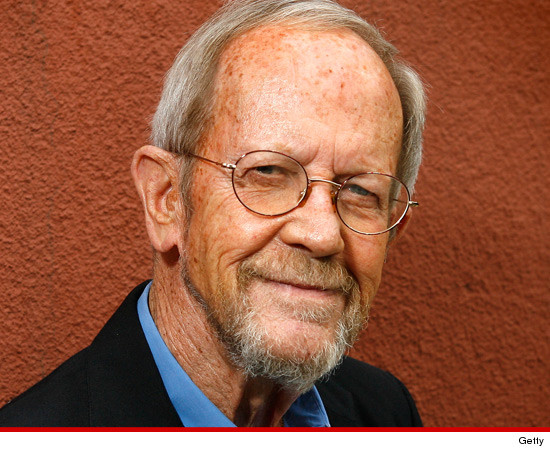
Elmore Leonard the novelist and screenwriter responsible for the story
and characters in the first place, left us at age 87. I'm not suggesting
there is a curse or anything, but if this film does not get included
before anyone else from the cast dies, I will feel terrible. "Get
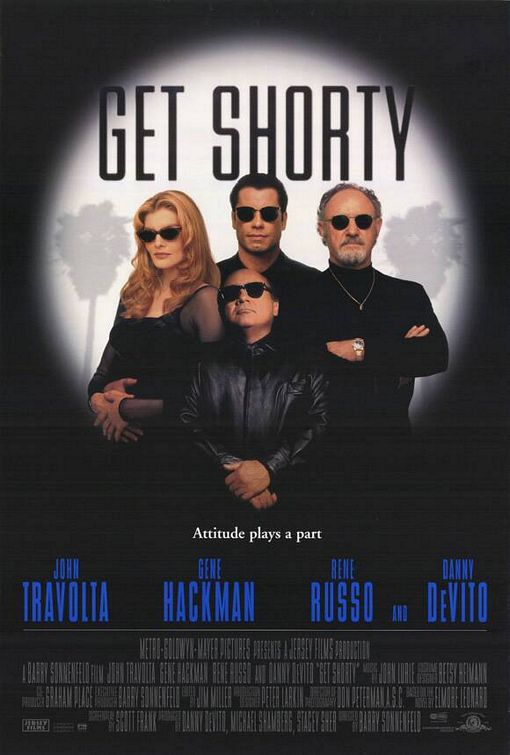
Shorty" is a star vehicle, and it featured John Travolta in a great part
immediately after his comeback role in "Pulp Fiction". In spite of the
obvious star driven nature of the film, there is a great ensemble cast
that adds to the quality of the movie and makes it something I think
everyone will be glad to have seen.
For
movie fans, this is a film that should give them a warm feeling in
their dreams. This is a gangster movie about gangsters who want to make a
gangster movie. There are dozens of colorful characters both in the
crime world and in Hollywood as the story gets told. The crime stuff may
be accurate, someone with a better sense of that can judge for us, but
the movie end of the story cuts incredibly close to the bone that is the
film making process. Last year in the movie "Argo", John Goodman's
character summed it up this way:
John Chambers: [after hearing of the plan to get the hostages out] So you want to come to Hollywood, act like a big shot... Tony Mendez: Yeah. John Chambers: ...without actually doing anything? Tony Mendez: Yeah. John Chambers: [smiles] You'll fit right in!
That
is the plot of this movie. Everyone thinks they can be in the movie
business and they are right. Yet being in the movie business does not
always mean making a movie, sometimes it is about talking about making a
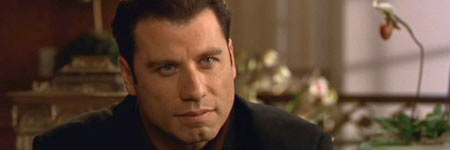
movie. Our lead character Chili Palmer, played by John Travolta is good
at talking.
Look At Me
Chili
is a loan shark from Miami, who ends up in Hollywood while running down
a customer who has tried to outsmart the mob. He is not a thug but he
is not a pushover by any stretch of the imagination. Chili is the kind
of guy who is usually too smart for everyone else in the room. He is
also a movie fan and like many other fans of film, he thinks he can do
better than the people who are currently making it in "Tinseltown". The
plot involves him trying to find financing and a star for the movie he
has in his head. That's right, the movie in his head. There is a
screenplay for another movie that is pivotal to the plot, but most of
what we see on the screen is the movie that Chili sees turning into his
own film. It's a movie about a loan shark who comes to Hollywood in
pursuit of a bad debt. He is making up the movie out of his life story
as he is living it. That is a pretty awesome way of creating a screen
story, if only all of us could lead an interesting enough life to do
that, we would be able to get rid of all the remakes and sequels that
come out of the film world today.
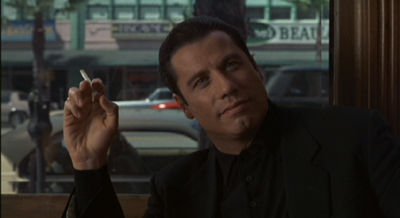
Travolta
is a walking advertisement of "cool" in this film. He dresses in a
sharp manner that doesn't seem ostentatious, he looks great in
sunglasses and finally, he may be able to set the anti-smoking cause
back by ten years. When he lights up and stares down an adversary, it is
a moment everyone in the business will want to emulate. Travolta was at
the top of his game in the moment this film was made. He was natural,
charismatic and he had an everyman touch despite the fact that it was
clear he was not everyone. Warren Beatty was apparently offered the
role, and from the looks department and the cool factor you can
understand why he seemed a good fit, but Travolta has a sense of humor
in his eye that makes the part work, and when he drops the veneer of
friendliness he feels dangerous in a way that I think Beatty would not
have been able to match.
In
addition to Chili Palmer, there are a dozen other characters that
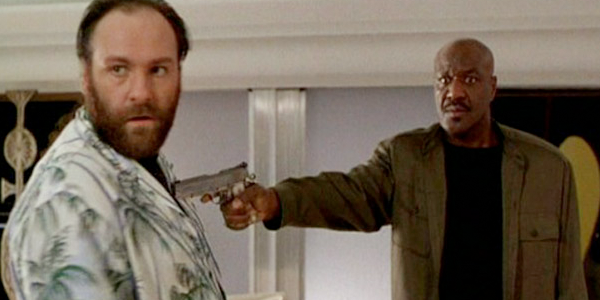
flicker around the flame of Hollywood success. Delroy Lindo, a
charismatic presence himself, plays Bo the drug dealer. Bo wants into
the business of movies and sees an opportunity to leverage himself in
because a director owes him a large sum of cash. Another
debt that Chili is trying to recover is owed by that director and Chili
manages to insert himself into the process of making movies ( or more
accurately movie deals) by trying to extricate the director from his
entanglement with the drug dealer. Bo has a partner and an enforcer. The
enforcer is a giant of a man who was once a stunt guy in the movie
business. "Bear" is played by the late James Gandolfini as a menacing
but ultimately ineffective threat. Muscle alone will not be sufficient
to put Chili Palmer out of the deal. This is the first time I remember
Gandolfini from a movie role. He had a sweet disposition for a thug and
his wardrobe was California casual to the max. The big beard and long
pony tail he came equipped with was authentic for the times, I know because I saw it in the mirror every day in the 1990s.
Every
comedy has to have a fool somewhere, otherwise everyone would just act
in their best interests and reason would dominate rather than laughter.
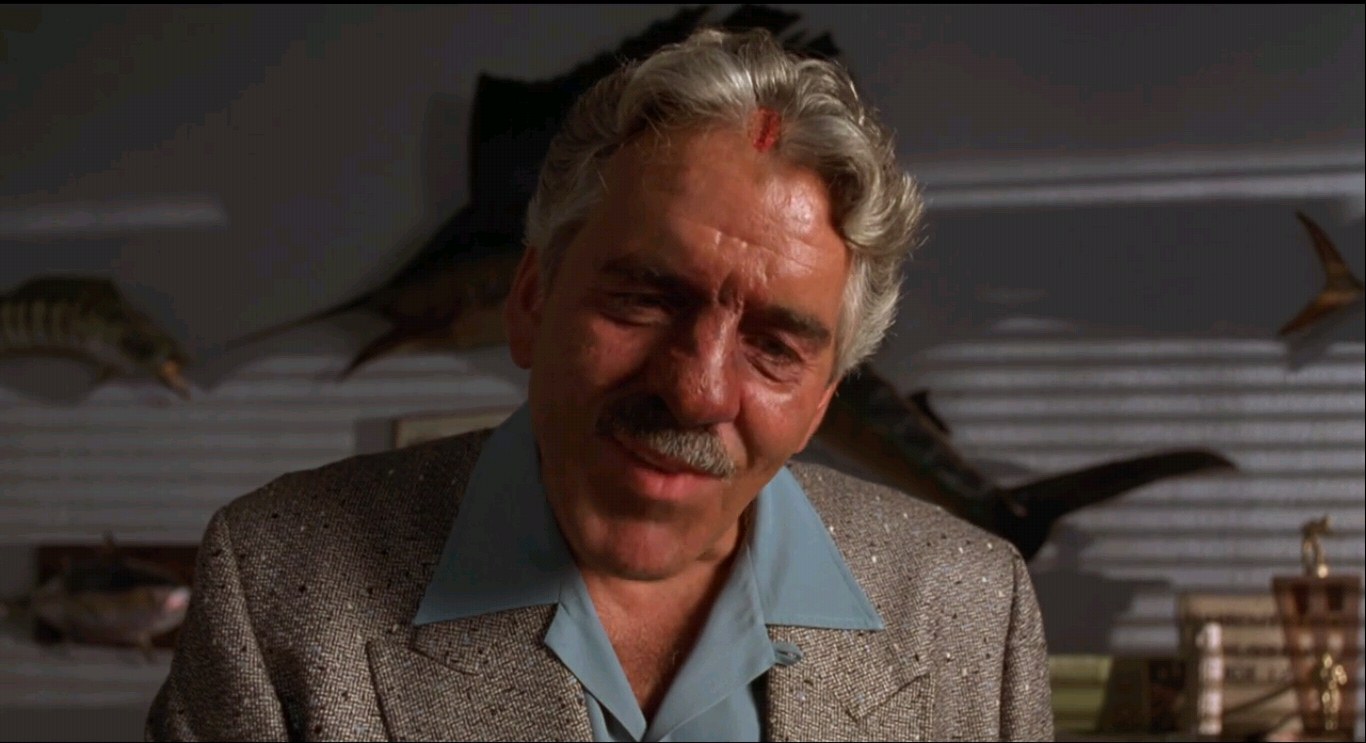
"Get Shorty" has the biggest self deluded fool in Hollywood; low budget
exploitation director/producer Harry Zimm. Harry wants to play with the
big boys but we know he doesn't have what it takes from the beginning.
Harry owes a Vegas casino, he owes a drug dealer, he has a script he
can't quite get control over and a girlfriend who is way too smart for
him. Casting gives this movie another secret weapon, Gene Hackman.
Pound for pound, movie for movie, I would put Hackman up against any
other actor of any time, but he was not always thought of as a comedian.
That makes no sense in light of the Superman movies where he was the
antagonist and the comic relief at the same time. His three minutes in
"Young Frankenstein" may be the highlight of one of the greatest
comedies ever made. He turned down the part originally because he did
not usually do comedies. Zimm is a funny character not because he makes
jokes but because he is a parody of the movie business itself. Hackman
just had to play a character who was so clueless and yet so certain that
he could really be a Hollywood figure. He nailed it.
One of his funniest lines comes when he can't even speak because of a
beating that he took. Crawling out of the hospital to make it to a lunch
with the potential star of his breakthrough quality picture, Chili and
Karen, Harry's girlfriend, wonder what the hell he is doing at the lunch
meeting at "The Ivy" in his condition. Harry can only croak out the
phrase "My project" through his jaws that have been wired shut. That is
a true sense of commitment from a producer protecting his interests.
So
far our focus has been on the Hollywood element, let's not neglect the
gangster part of the story. Bo and his partners have problems of their
own, a South American drug lord has come in search of money and a lost
nephew. The FBI is watching money that has been stored in an airport
locker, and Bo tries to trick Chili into exposing himself to get at the
cash. Harry's big mistake in addition to not listening to Chili earlier
and getting more deeply involved with Bo, is that he thinks he can big
shot his way around the mob.
Harry makes the mistake of trying to go it alone and contacts Chili's
gangland connection in Miami, hoping to shake loose some cash for his
film. Enter Ray "Bones", played with the usual gusto by Dennis Farina.
Farina played gangsters in dozens of projects (he also played cops
pretty well being a former Chicago cop himself). Farina had a poetic way
of delivering a line with complete disdain and superiority. His
conversations with just about everyone in this film suggest a barely
contained rage at how idiotic he thought everyone else was. From the
start of the film, he was the east Coast version of Harry Zimm, too big
for his britches and not able to really stand toe to toe with Chili
despite his elevated position of power. The scene where he and Harry
meet is a high point of comedy in the movie. It is violent and abusive
in the way that modern gangster films are wont to be. It is also
hysterical.
Rene
Russo is Karen, a b-movie scream queen, and Harry's girlfriend. It
doesn't take long for Chili and Karen to connect because they are the
two most intelligent characters in the movie. Whenever Chili is
confounded by some stupidity in Hollywood, Karen is right there to to
interpret for him. Russo is completely believable as a working actress
who should know better and has greater ambition than originally seems.
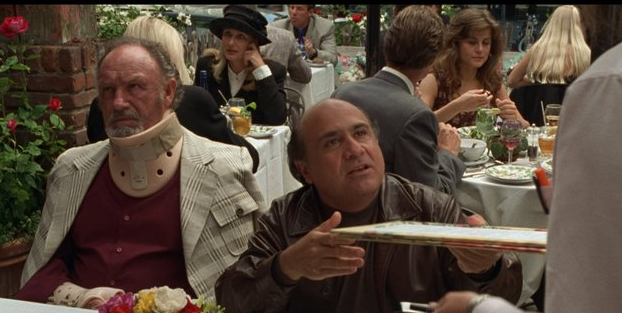
As the ex-wife of movie star Martin Weir, she connects Chili and Harry
to some real power in Hollywood, a major star. Danny Devito seems like
an odd candidate for the role but he channels his friend Jack Nicholson
and creates an actor who is serious about his work but indifferent to
how it effects others. In the film "The Player" Tim Robbins' character
orders a different kind of fashionable water at every meeting, and then
he never drinks. Martin Weir special orders food and then never takes a
bite. It is one of the irritating ways that the pecking order in
Hollywood might be measured.
In
the background of the story are several other perfectly cast
characters. David Paymer does nervous and combative at the same time.
Bette Midler, who was unbilled in the film, does sexy and smart ass.
Miguel Sandoval has made a living playing drug lords and government
officials. Here he is menacing as he discusses taking in the Universal
Tour and then maybe murdering some of the other characters in the movie.
There is a long line of character actors who all bring this movie some
realism and personality.
The
director Barry Sonnenfield should get a lot of credit for making the
movie play so well. There are great tracking shots that don't call
attention to themselves but make the movie feel even more movie like.
The look of all the locations is also important. Martin Weir's arrival
for lunch at "The Ivy" is staged like a red carpet moment for an every
day Hollywood activity. Harry's office looks rundown, over stuffed and
heavenly to a movie fan who would love to have those kinds of film
mementos on the walls and bookshelves. Bo's house in the Hollywood Hills
is both pretentious and strangely attractive.
The real hero of the movie though is the creator of all of these characters, the late Elmore Leonard.
His book is really the script for the movie. Scott Frank is credited
with the screenplay and he and Leonard shared the same relationship on
another project "Out of Sight" a couple of years later. Leonard's
plotting and dialogue keep us involved. The actors bring the characters
to life and it all comes off as a good natured poke in the eye to the
movie business that is responsible for putting this out in the first
place. In light of all the recent passings, it is a good time to embrace
the quality of this film and remember how much a talented cast of
professionals can do to entertain us. "Get Shorty" may have been a star
vehicle for John Travolta, but it was a project that showed us that real
stars are found in every well cast part.
Richard
Kirkham is a lifelong movie enthusiast from Southern California. While
embracing all genres of film making, he is especially moved to write
about and share his memories of movies from his formative years, the
glorious 1970s. His personal blog, featuring current film reviews as
well as his Summers of the 1970s movie project, can be found at Kirkham A Movie A Day.
OK, I'm going to out myself as an old man right now. As Steven Spielberg is to my kids and most of the movie going generation after, Francis Ford Coppola was to my generation. He was the inspiration for my movie mania in the 1970s. He is responsible in whole or part for five Best Picture nominees including three winners in that category. Getting a chance to hear him speak was number one on my list of "must dos" for the Festival. We were not at the front of the line but we were there almost two hours early to insure that we did get in. Mr. Coppola did not disappoint.
There was an elaborate description of the opening scene that reoccurs as the movie plays out. The idea that more is revealed or that the comments being made are interpreted in a different way as we get some more context is an early version of a technique used by later films like "Memento"and "Crash ". That Walter Murch had to be given a title that did not exist before [Sound Designer] because he technically could not work as an editor is a testament to the clash between the old ways that studios worked and the new styles that film makers like Coppola wanted to employ. The innovative use of sound in this film was the start of a specialized field. I wonder how Ben Burtt feels about this and if he would agree.
Gene Hackman is my favorite actor, and this was a terrific part that required him to be very different than in other roles. He is introspective and something of a schlep in his plastic raincoat and black rimmed glasses. He still has the volatility of Popeye Doyle, but it is tempered by a meekness that is surprising. When he tosses away his valise in frustration, that's a moment you expect, but when he turns around to go back and get it, that is not the performance choice that is typical, but it is reflective of the character. His passive-aggressive manner with his girlfriend is another indicator of Harry Caul's tentative ability to connect with others. We know that he is in over his head when he gets bested by a professional rival in a joke, but even more so when he falls into a honeypot that is designed to get access to materials he has held back from the assistant to his contracted employer. Robert Duvall is barely in the movie, in fact I think he is uncredited, but it is nice to see the two of them occupying the same film.
The timeliness of this kind of surveillance is odd. The movie is more than forty years old but it is still relevant with the privacy invasions that we see today in politics, social media and National Security issues. Harry's paranoia is just a precursor to the kinds of intrusions that all of us are subject to today.


 For
movie fans, this is a film that should give them a warm feeling in
their dreams. This is a gangster movie about gangsters who want to make a
gangster movie. There are dozens of colorful characters both in the
crime world and in Hollywood as the story gets told. The crime stuff may
be accurate, someone with a better sense of that can judge for us, but
the movie end of the story cuts incredibly close to the bone that is the
film making process. Last year in the movie "Argo", John Goodman's
character summed it up this way:
For
movie fans, this is a film that should give them a warm feeling in
their dreams. This is a gangster movie about gangsters who want to make a
gangster movie. There are dozens of colorful characters both in the
crime world and in Hollywood as the story gets told. The crime stuff may
be accurate, someone with a better sense of that can judge for us, but
the movie end of the story cuts incredibly close to the bone that is the
film making process. Last year in the movie "Argo", John Goodman's
character summed it up this way: